
When human beings look at the information concerning an IP address, they tend to have a simple question: What can an IP address actually tell someone about me?
The IP tracking, privacy, and online identification have a lot of misconceptions. There are users who believe that an IP address discloses personal information and users who undervalue the specialized worth of the same.
In this article, we fully describe what we can learn about an IP address only and what we cannot, also how tools such as the IP Info option of Site Info Check can provide us with this information in an open and privacy-minded manner.
What Is an IP Address?
An Internet Protocol or “IP” Address is a unique numerical identifier assigned to your Computer or Other Devices connected to the Internet for the purpose of establishing a communication link to other computers/devices on the Internet. Essentially, an IP Address tells the Internet where to send/Receive Data, which enables users on Different Devices (e.g., Computers, Smartphones, etc.) connected via a network (i.e., Internet) to communicate with One Another.
There are two types of IP Addresses being used today:
1) IPv4 Addressing System; This most widely utilised way of assigning IP addresses has an address format made up of four groups of numbers separated by periods.
2) IPv6 Addressing system; Differences Between IPv4 & IPv6 Include: IPv6 Addressing systems use very Long hexadecimal values as opposed to simple number formats.
Note: An IP Address is a Network connection Identifier (NIC), rather than identifying an Individual User. An IP Address provides the Technical & Routing Information about a Network, but does not Connect You to Your Personal Identity.
What Information Can Be Extracted From an IP?
Using an IP address, you can access a variety of types of technical information and general location information (which is displayed by most IP lookup tools) that are often used in the areas of networking, security, analytics, and troubleshooting. The IP version (IPv4 or IPv6) allows network administrators and developers to determine if the IP address can be routed, how it will be routed, and what the requirements are for infrastructure (hardware and software).
ISP and Organization
The company that owns or manages the Internet Service Provider’s (ISP) IP range is a trusted source of information regarding any individual’s or business’s IP address.
For example, an IP address could belong to an ISP, mobile provider, a hosting organization, or Google LLC (as a public DNS provider).
The information derived from this relationship can help with:
- [Network Diagnostic Information] / Network Diagnostics
- Traffic Analysis
- Identifying Hosting/Cloud Provider(s); and
- Identifying Auto/Non-Residential Traffic.
ASN (Autonomous System Number)
The rest of the larger network to which the IP address is controlled is denoted by an ASN (Autonomous System Number). It is the autonomous systems that control the route of the internet traffic and are commonly handled by ISPs, cloud providers, or big organizations.
ASN data is commonly used in:
- Network monitoring
- Security analysis
- SEO and log analysis
Docs affecting the infrastructure.
The ASN can be used to know who is routing the traffic, which is also not simply the one providing end-user access.
Reverse DNS and Hostname
Reverse DNS lookup tries to reverse an IP address to appear as a hostname.
When it can be, it can also give leads as to the purpose the IP is being used; whether it is a mail server, a DNS server, or just the infrastructure.
The IP addresses do not contain reverse DNS records, and hostnames are mostly generic. They can, however, be useful when they are available to perform technical analysis and validation.
Geographic Location (More or Less).
The IP geolocation databases have the potential to approximate the overall physical location of an IP address. This usually includes:
- Continent
- Country
- Region or state
- City (in some cases)
- Latitude and longitude syllables.
- Timezone
It is important to mention that this is only approximate location data and not exact. The coordinates are frequently an ISP, a routing or infrastructure switch, rather than an individual or address.
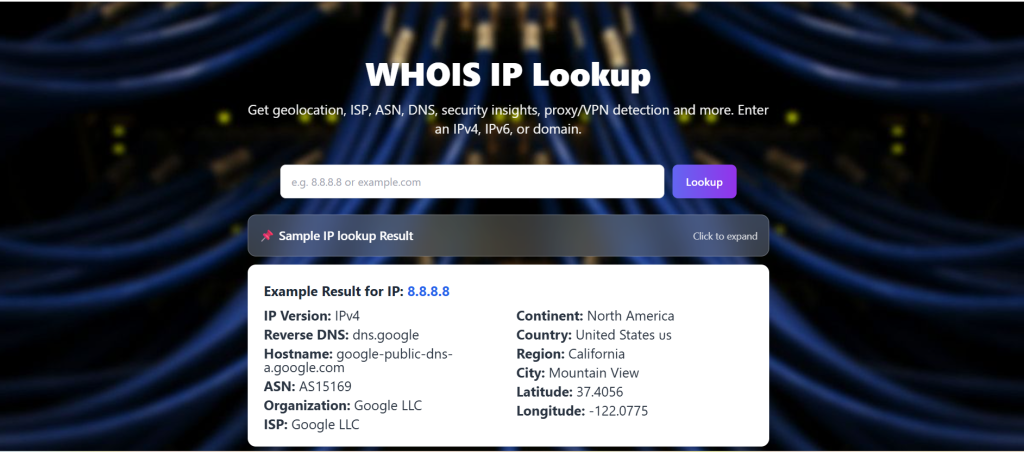
Sample IP Lookup Result (Actual Sample)
The following is a sample of the display of IP information with the help of the IP Info tool under Site Info Check:
Location: Ashburn, the US.
Network Information
- ISP: Google LLC
- Company name: Google Public DNS.
- ASN: AS15169 Google LLC (GOOGLE)
- Reverse DNS: dns. google
Location & Details
- Region: Virginia
- Timezone: America/New_York
- Coordinates: 39.03, -77.5
- Mobile: No
Data of each field is technical or routing-related. No such details associate a particular user. Rather, it outlines the connection of the IP with the larger internet architecture.
How Accurate Is IP Information?
Many elements affect the accuracy of an IP address. These include:
- How frequently the information is updated in the IP database (most databases are updated regularly, but not necessarily immediately)
- The method by which the Internet Service Provider (ISP) routes IP addresses (for example, through centralised hubs, etc.)
- The type of IP address (there are differences in how residential, mobile, corporate, and Data Centre IP addresses function)
- The usage of VPNs and proxies to mask the IP address connection
When evaluating the different levels of accuracy associated with IP addresses:
- IP addresses are generally accurate at the country level
- IP addresses are often accurate at the region and city, but not guaranteed to be so
- IP addresses cannot provide an accurate location without additional context.
Since IP address lookup services should not be used as a substitute for accurate geolocation services.
What is Information that can not be obtained in an IP?
This is among the crucial parts in terms of explicitness and credibility.
An IP address cannot reveal:
- A person’s name or identity
- Precise home or office address.
- Telephone numbers or e-mails.
- Social media profiles
- A device or account, or file access.
IP addresses are not used as personal identifiers. It is wrong to make any arguments that an IP itself can reveal personal, intimate information.
IP Info Use Cases on Site Info Check
The Site Info Check, which includes an IP Info component, is not a tracking tool; it should be viewed as having both analytical and informational use cases.
Multiple reasons to use the site include:
- Find out the source of web traffic
- Identify the ISP or hosting provider (or Cloud) where a site is hosted
- Facilitate the security review process and detect anomalies
- Assist SEO professionals in identifying errors in their log files or when doing log file analysis and crawling diagnostics
- Provides a record of the configuration of your network and server
The information will be presented in a straightforward manner without overstating relevance and will provide sufficient context for limitations and privacy considerations.
Conclusion
An IP address yields techy and rough geographic location data—but not an actual person’s identity. An IP provides info about the Network (NIC) Provider and the geographic area it covers, but does not provide info on the Owner or user’s identity or location.
Tools such as Site Info Check’s IP Info can help interpret and utilize IP information while maintaining user privacy and setting proper expectations. Users should understand what they can learn from an IP address while also knowing how to interpret that information in order to minimize unnecessary worry or confusion.


Leave a Reply to Wan AI Cancel reply