
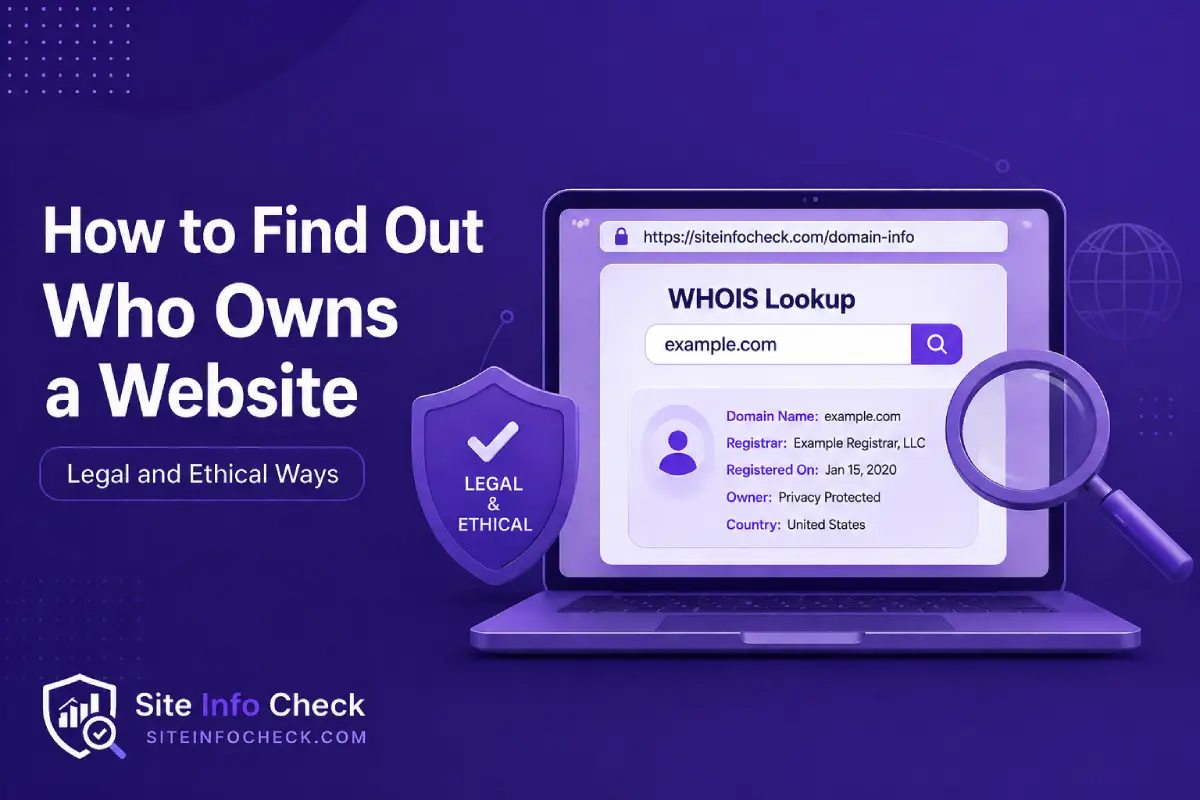
Business owners, researchers or even regular users might ask themselves this question:
Who actually owns this website?
Maybe you’re checking a potential supplier, researching a competitor, verifying a new online store, or just want to make sure whether a website is legitimate before engaging with it. Wanting to know this information is completely reasonable, but how you look for it matters. It’s very important to obey the law and avoid legal and privacy pitfalls.
There are legal and ethical ways to find website ownership information, and there are also clear boundaries set by privacy laws in the US and the UK. Understanding those boundaries will save you time, confusion, and potential legal trouble.
Why Website Ownership Isn’t Always Obvious?
Years ago, finding out who owned a website was much easier. Domain registration records often displayed detailed data such as names, email addresses, and even phone numbers. That’s no longer the case, and for good reason.
Modern privacy regulations are designed to protect individuals and businesses from spam, harassment, and data misuse. As a result, much of the personal information once visible is now hidden or anonymized.
So if you don’t see the owner’s name or any other ownership information, that doesn’t automatically mean that the website is suspicious. In fact in most cases, it simply means the owner is following best privacy practices.
What WHOIS Data Really Is (and What It Isn’t)?
WHOIS is essentially a public record system for domain names.
When someone registers a domain, certain technical and administrative details are recorded so the internet can function reliably and transparently.
Today, WHOIS data usually focuses on:
- When a domain was registered
- Which registrar it uses
- Technical configuration details
- Whether privacy protection is enabled
What it usually does not show anymore is direct personal contact information, especially for individuals and small businesses.
This change often surprises people, but it’s now an accepted global standard.
How Privacy Laws Changed Domain Ownership Visibility?
Regulations like GDPR in the UK (and in Europe in general) and similar data protection frameworks globally reshaped how domain data is displayed to prevent unwanted personal information disclosure.
Because of these laws:
- Registrars must limit exposure of personal data
- Many domains show “redacted” or proxy information (such as Cloudflare)
- Contact details are often replaced with anonymized forwarding systems
It’s important to know that this doesn’t reduce accountability. It simply changes how and what information can be accessed and protected.
How to Research Website Ownership Responsibly?
If you want to understand who’s behind a website, the best way is to combine technical context with visible signals, rather than trying to “unmask” someone. Remember, if you are not a security specialist or someone who has permission to gain deep information about a website (like a penetration testing contract or under a bug bounty program), DO NOT use security or OSINT tools blindly, specially the ones that you were told to install or run in your system’s CMD or Terminal to get some information. Even if you don’t find any personal data regarding that website’s owner, the attempt itself might have legal consequences. It’s just better for a regular user who does not have technical expertise to just scratch the surface and use online tools to find ownership information and not go deeper, just in case. This is one of the reasons that we have a domain info lookup tool in our website.
A domain info lookup tool can help you see when a domain was registered, how long it has existed, and whether ownership details are protected. This alone tells you a lot. A long-standing domain with consistent registration history is very different from something created days ago. But it’s good to know that all tools have limitations and as said before, to go steps deeper, there needs to be some technical expertise and combining multiple tools or methods together to get as much data as possible.
At the same time, there is a much easier way, that believe it or not, sometimes provides information far better than technical methods. The website itself often provides clearer answers than WHOIS ever could. Legitimate businesses usually explain who they are through About pages, legal notices, company details, and contact information. These signals are intentional and far more meaningful than raw registration data and more human readable compare to WHOIS records that contain some keywords unknown to some users.
Using a domain information tool like the one available on site info check helps add technical context to what you already see, without crossing ethical or legal lines.
Understanding the Limits (and Why They Exist)
Now we know and accepted that some information is not meant to be public.
Privacy protection doesn’t mean secrecy, it means controlled access.
You should expect that some ownership details are meant to be hidden, contact information is indirect and data is mostly technical rather than personal.
Trying to bypass these protections and gain deeper information about the owner, is not only unethical, but often illegal.
Common Misunderstandings About Hidden Ownership
A very common assumption is that hidden ownership equals risk. In reality, many reputable companies and professionals use privacy services simply to reduce spam and protect internal teams. In fact it might be a great sign that the company has security in mind and respects it’s users, or maybe not, who knows.
Another misunderstanding is assuming WHOIS data is always accurate or up to date. Just so you know, if you want to access more accurate data and more information in general, you must know that there isn’t only a single way to do that. Just to give you an idea how it can be done which is a nice method applied by security professionals, take a look at this technique:
- You find the favicon of the website and calculate it’s hash in MD5
- You can search the hash in Shodan website (a power full web reconnaissance engine)
- It will show you websites that have the same hash therefore they have the same favicon which can mean the same person or team has designed or owns them
- Now simply you have multiple websites to investigate deeper and find their WHOIS information as well which might lead you to more accurate information
This was just a simple demonstration to show you that finding information about an owner, is not as simple and straight forward as you might think. Experts often create their own method of investigating, they use multiple tools and with a bit of creativity, they find information that most people can’t or miss them.
That’s why ownership research is not about single data points.
Frequently Asked Questions
Is it legal to look up who owns a website?
Yes. Accessing publicly available domain data is legal. Misusing that data is not.
Why can’t I see names or email addresses anymore?
Because privacy laws require registrars to protect personal data, especially for individuals.
Does private WHOIS mean the site is unsafe?
No. Privacy protection is common and often recommended.
Can WHOIS data be wrong?
It can be incomplete, outdated, or intentionally limited. That’s normal.
Is there any way to contact a website owner if details are hidden?
Often yes and indirectly. Many registrars provide anonymized contact forms that forward messages securely.
Final Thoughts
Finding out who owns a website today is less about uncovering personal details and more about understanding credibility, history, and transparency.
By respecting privacy laws, using domain information tools responsibly, and paying attention to what websites openly disclose, you can make informed decisions without crossing ethical boundaries.
If your goal is due diligence, not intrusion, combining visible website signals with a reliable domain info lookup gives you clarity while staying on the right side of the law.
Leave a Reply